Imagine starting your day with a cup of coffee that hits all the right notes: rich aroma, balanced flavor profile, and just the perfect brew strength. That’s the magic of tweaking advanced brewing variables. This article dives deep into how you can experiment with key factors like grind size, water temperature, and brew ratio to elevate your home brews from good to exceptional.
We’ll cover the fundamentals, step-by-step experiments, and troubleshooting tips. Mastering these will help you unlock nuanced tastes tailored to your beans, moving your brewing from a simple routine to an informed craft. It matters because small, precise changes can transform bland coffee into a sensory delight, saving money on cafe runs while boosting your skills. Before you begin, invest in consistent tools a quality scale for measuring mass and a thermometer for precise temperature control as consistency is the bedrock of experimentation.
What Are Advanced Brewing Variables in Coffee Brewing?
Coffee brewing is fundamentally a science of extraction. Water pulls flavors, acids, and compounds from grounds. Advanced brewing variables include elements beyond basics like using fresh beans and filtered water; they are the controls that fine-tune the extraction process.
The key ones are grind size, which affects surface area exposure; water temperature, influencing compound solubility; and brew ratio, dictating the final brew strength. These interact to control extraction yield and total dissolved solids (TDS), the primary metrics for brew quality. Specifically, the Specialty Coffee Association (SCA) Coffee Brewing Control Chart shows that the “Gold Cup Standard” is achieved when TDS (the concentration of coffee solids in the cup) falls between 1.15 and 1.45 percent and extraction yield (the percentage of the coffee mass dissolved by water) is between 18 and 22 percent. Hitting this zone is the goal of all variable adjustments.
Why experiment? Standard methods often underperform unique roasts or preparation methods. Adjusting variables lets you highlight fruity notes or reduce bitterness, tailoring the experience to the specific bean’s flavor profile.
The Role of Grind Size in Better Coffee
Grind size is a cornerstone of advanced brewing variables. Finer grinds increase surface area, speeding up extraction and increasing the risk of over-extraction. Coarser ones slow it down, preventing over-extraction but risking under-extraction.
For pour over coffee, a medium-fine consistency, similar to table salt, works well. Too fine clogs filters, leading to extended contact time; too coarse allows water to rush through, yielding weak brews.
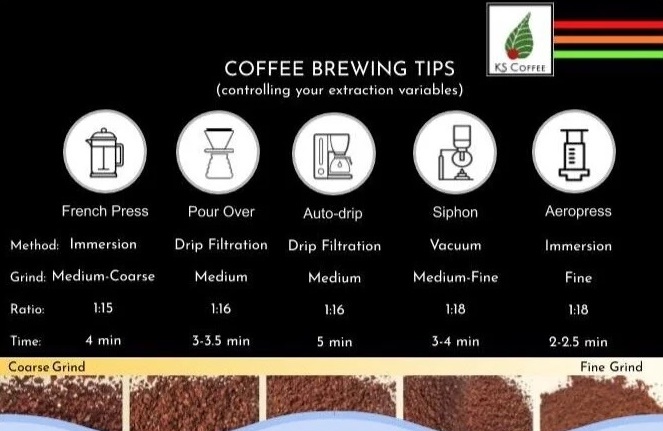
Experiment: Grind the same beans at three sizes coarse for French press, medium for drip, fine for espresso. Brew each and note the flavors. Finer grinds often amplify acidity and body but risk bitterness if overdone. For instance, an extremely fine grind on a light-roast Ethiopian Yirgacheffe might turn its bright citrus notes into an unpleasant, sharp sourness due to under-extraction or a chalky bitterness from over-extraction in different scenarios.
Optimizing Water Temperature for Superior Extraction
Water temperature directly impacts how compounds dissolve. The ideal range for hot brews is 195 to 205 degrees Fahrenheit (90.5 to 96 degrees Celsius). Hotter water extracts faster, pulling more solubles but increasing the risk of bitterness and a “burnt” taste.
Cooler temps, around 185 degrees (85 degrees Celsius), suit delicate light roasts to preserve volatile, delicate flavors. For cold brew, room temperature or below extracts slowly over many hours, yielding a distinctively low-acidity result.
Experiment: Brew the same coffee at 195, 200, and 205 degrees Fahrenheit. Taste for balance: too hot may taste burnt or dry; too cool, sour or weak. Use a gooseneck kettle for precise control over the pour. Importantly, this variable pairs with others: a slightly lower temperature used alongside a coarser grind size can still achieve optimal extraction yield because the combined effects of slower solubility and slower flow rate can balance out the total extraction time.
Mastering Brew Ratio and Strength
Brew ratio is the coffee-to-water mass by weight, such as 1:16 (1 gram of coffee for 16 grams of water) for a balanced cup. Stronger ratios (e.g., 1:12) suit bold tastes, while weaker ratios (e.g., 1:18) result in a milder cup.
The ratio primarily affects caffeine content and body. A 1:15 ratio often hits the sweet spot for drip methods.
Experiment: Fix all other variables (grind size, temperature, time) and vary the brew ratio: 1:14, 1:16, 1:18. Measure the output weight for accuracy. Stronger brews will naturally have a higher TDS and greater body but can overdo the concentration of tannins, leading to a drying sensation. To truly dial this in, advanced enthusiasts can use a TDS refractometer; aim for the 1.15 to 1.45 percent TDS sweet spot.
Extraction Time and Agitation
Extraction time is the duration water contacts the grounds. It is short for espresso (25–30 seconds) and longer for immersion brewing (e.g., 4 minutes for French press).
Agitation, like stirring or turbulence from a pour, boosts extraction by mixing the slurry and ensuring uniform contact. In pour over coffee, pulse pours create controlled turbulence.
Experiment: For pour over, vary the total brew time between 2.5, 3, and 3.5 minutes. For immersion brewing, gently stir the slurry at the start for evenness. The rule of thumb: a shorter extraction time requires a finer grind size to compensate, and a longer time allows for a coarser grind. Monitor for under-extraction (sour, weak, lacking sweetness) or over-extraction (bitter, dry, astringent). The combined goal of grind size, time, and ratio is to achieve that 18-22 percent extraction yield.
Water Quality as a Hidden Brewing Variable
Pure water is approximately 98 percent of your brew. The mineral content (water quality) significantly affects taste; water that is too soft lacks body, while water that is too hard can scale equipment and muddy the flavors.
Use filtered water with 50-175 ppm (parts per million) total hardness. Third wave standards recommend a specific, balanced ion profile.
Experiment: Brew with regular tap water, quality bottled water, and a specifically remineralized brewing water. Taste the difference in clarity, acidity, and mouthfeel. For detailed guidance, consult the Specialty Coffee Association guidelines on water protocols.
Advanced Methods and Variable Application
Applying Variables to Pour Over Coffee Techniques
Pour over coffee (e.g., V60 or Kalita Wave) allows the most precise variable control. Start with a baseline: 1:16 ratio, medium-fine grind size, 200 degrees water. Bloom the grounds with twice the coffee weight in water for 30 seconds.
Pulse pour in stages: 50g bloom, then steady 100g pulses. Aim for a total extraction time of 2:30–3:00. Experiment by varying the pour height: a higher pour creates more agitation (turbulence), potentially extracting brighter, more acidic notes; a lower, gentler pour reduces turbulence for a cleaner, often sweeter cup.
Immersion Brewing: French Press and AeroPress Experiments
Immersion brewing soaks the grounds completely. For French press, use a coarse grind, a 4-minute steep, and a 1:15 ratio. Press slowly to minimize sediment. Experiment with steep time: 3 minutes (lighter body) vs. 5 minutes (fuller body).
The AeroPress can be inverted for immersion. Use a finer grind, a short steep time (30–60 seconds), and a concentrated brew ratio (e.g., 1:8). Vary the pressure applied: gentle for a cleaner cup, firm for a bolder, more extracted result. These methods naturally highlight more oils and texture.
Cold Brew and Advanced Cold Extraction Variables
Cold brew uses a coarse grind, a strong brew ratio (e.g., 1:8), and a long steep (12–24 hours) at room temperature or in the fridge. The lower temperature slows extraction, dramatically reducing the compounds that cause acidity for a smooth taste. Experiment by agitating the grounds midway through the steep or by filtering the final product twice for better clarity.
Espresso: Pressure and Dose Variables
Espresso is the most demanding method, tweaking dose (e.g., 18g), pressure (9 bars), and temperature (e.g., 93°C). The key is a very fine grind calibrated to achieve a 25-second pull time for a standard shot. Dial in by tasting shots: blonding (a change to pale color) signals the final, undesirable stage of over-extraction.
Tools and Systematic Tracking for Success
Successful experimentation relies on precision. Use a digital scale for mass-based brew ratios, a timer for precise extraction time, and a quality thermometer for water temperature. For consistency in grind size, a grinder with repeatable settings is essential.
Log your brews: Document the bean origin, all advanced brewing variables used, and your sensory evaluation notes. This record transforms random attempts into a reproducible science. Simple notebooks or dedicated apps can track your flavor profile and prevent repeating mistakes.
Your Path to Better Coffee
Experimenting with advanced brewing variables transforms coffee brewing from a morning routine into a conscious, rewarding art. The journey from a basic cup to a truly exceptional one is paved with systematic adjustment and careful sensory evaluation. Start small, change only one variable at a time, track your results, and enjoy the process of discovery. Soon, you’ll not only craft better coffee but also understand why it tastes so good, consistently achieving the Gold Cup standard every time.
Disclaimer:
This article provides general guidance for coffee experimentation. Results vary by equipment and beans; consult professionals for health-related concerns.